

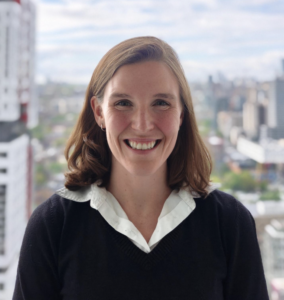
Dr. Jessica Willis
Introduction
Dr. Jessica Willis is an adolescent medicine physician and general pediatrician in her second year of practice in Sault Ste. Marie in Northern Ontario. She balances a busy adolescent medicine consulting practice along with providing medical consultation for the eating disorders program and acute care pediatrics and neonatal intensive care coverage at Sault Area Hospital. Highlighting how wonderfully she has transitioned into staff life, and her advocacy for adolescent medicine in their region, she was nominated for Pediatrician of the Season by her Department’s Chief of Pediatrics, Dr. Jonathan Dellavedova.
Dr. McConnery: Dr. Willis, congratulations on your nomination. To start off, can you tell us a little about your path to Sault Ste. Marie?
Dr. Willis: “I did my residency in London for pediatrics, and then I went to SickKids for my adolescent medicine fellowship.” After fellowship, Dr. Willis knew exactly what kind of practice Dr. Willis was looking for: “I didn’t want to go full AdMed and lose my Gen Peds skills, so I figured, I’ve got to find somewhere I can do a little bit of both.”
Dr. McConnery: And what made Sault Ste. Marie the right fit?
Dr. Willis: “I loved my community rotations in residency,” and knew a smaller community might be the right fit. Sault Ste. Marie also had personal significance: “My mom’s from the Soo, and the clinic I work at now, my grandma was a nurse there when it first opened.” Just as important, the pediatric team felt like the right match. “Dr. Dellavedova and the whole group was super nice and welcoming, and the team just felt really collegial.”
“I was really hoping for some mentorship as I got back into Gen Peds after my fellowship,” and the mix of work and lifestyle made the move feel right. “We love the outdoors. I love running and hiking and stuff, and where better to do that than Sault Ste. Marie?”
Dr. McConnery: You’ve now been there just over a year, and already making a major impact. What has it been like practicing pediatrics in Northern Ontario?
Dr. Willis: “It’s great. I actually love working here. I try to recruit all my friends to work here.” Dr. Willis described the environment as highly collaborative and adaptable. “Everybody has to be pretty flexible,” and because of that, “the environment at the hospital, at the clinic, is very flexible, and everyone’s really adaptable.”
“If I don’t know how to do something, I can call someone else up at the hospital, and they’ll come and help me, and it goes vice versa.” In Dr. Willis’s view, one of the biggest strengths of practicing in the North is that “there’s so much less ‘siloing’ care,” because teams simply have to work together. “It’s a really wonderful place to be… 10 out of 10 would recommend.”
A Week in the Life
Dr. McConnery: What does your practice look like right now?
Dr. Willis: “My primary practice is a general adolescent med practice,” with work focused on “gender care, substance use, mental health, sexual health, IUD insertions, that kind of stuff.” In addition, “I have a day a week where I go over to the eating disorder program, and I do the consults for them, and medical follow-up is part of my role there.”
Hospital work remains a major part of the role as well. “A few times a month, we do 48-hour call shifts at the hospital, and that’s where we cover the NICU and Gen Peds.”
Dr. McConnery: That’s an incredible amount of variety. I’m struck. What does a 48-hour call look like in your setting?
Dr. Willis: “It’s so variable.” Dr. Willis explained that the team rounds on NICU and pediatrics, and then “basically we’re just open for business.” Some stretches are quiet, while others can be intense: “We’re kind of like a low volume/high acuity. Sometimes you get the kids that are really sick, and those are going to be the kids that keep you up all night while you’re waiting for ORNGE to come and get them.”
Even then, the team dynamic makes a huge difference. “Our Peds team is very close-knit, we’re all very collegial,” and when things get busy, “there’s always someone who’s willing to come in and help.”
Advocacy and Leadership
Dr. McConnery: One of the things highlighted in your nomination was your work rebuilding the hospital-based eating disorder program. Can you tell us about that?
Dr. Willis: “When I first showed up, I just had my AdMed clinic, but I thought, I need to know this eating disorder program.” So Dr. Willis started by simply showing up: “I showed up at one of their team meetings, and we just started working initially informally on a relationship, and then it became more formal.”
At the time, the program had strong therapy support, but no dedicated medical provider. “They didn’t have any medical provider that was associated with their team, so it was really just therapeutic resources.” That created a major gap. “You couldn’t triage according to acuity,” and “their waitlist was over a year.”
Dr. McConnery: What changed once you got involved?
Dr. Willis: “The first thing that we did was build a triage system,” which included medical consults, assessing acuity, and offering follow-up while patients waited for therapy services. “Being able to offer a little bit of follow-up for those patients while they’re on the wait list,” helped start care earlier and made the system more responsive.
That work expanded over time. “Initially I was just serving people who were under 18, but I’ve since expanded up to 24 to be able to do the transitional age youth as well.” As a result, “we’ve been able to really shorten our wait list,” and the team has also started education sessions around the hospital, a research project, and work on protocols for these transitional age youth and adults in our hospitals.
Dr. McConnery: That expansion up to age 24 is such an important piece. What led to that decision?
Dr. Willis: “I was like, oh, I’m missing this huge group who are still young adults.” In Sault Ste. Marie, the need was especially clear because “we have such a primary care shortage in the community as well,” and some of those patients “didn’t have anybody to follow them medically either.”
From a clinical perspective, the decision made sense. “The difference between a 20-year-old and a 17-year-old with an eating disorder is not very much.” The main challenge, Dr. Willis said, was practical rather than clinical: “The biggest challenge for me was figuring out the billing piece of things,” as she highlighted it was doable within her scope and level of comfort from training (a fact she was sure to confirm with CPSO and CMPA).
Dr. McConnery: Another thing that stood out was your advocacy work in the community. How have you approached building those relationships outside the hospital?
Dr. Willis: “When I first moved to the Soo, I basically had a list of people. I was like, these are all the people that I want to meet when I move to the Soo.” With support from the hospital, Dr. Willis met local mental health providers, the Youth Wellness Hub, and the Sexual Assault Centre, among others.
“I just wanted them to know that I exist, but I also wanted to know what they do.” That groundwork has helped Dr. Willis identify gaps and connect patients more effectively. “If there’s something that I don’t know that is out there, or that I think should be out there, then I know who I can reach out to, to ask.”
Dr. McConnery: Can you give an example of how that relationship-building turned into actual service development?
Dr. Willis: “I have lots of patients that get referred to me for an eating disorder, and they don’t have an eating disorder, but they do have some disordered eating, or they have body image concerns that, if we could intervene now, we might prevent an eating disorder in the future.”
That led to a conversation with the Youth Wellness Hub. “I emailed the Youth Wellness Hub and was like, ‘hello, are you doing prevention work yet?’” From there, Dr. Willis and the team started discussing more formal body image support for young people, including “six sessions of body image work” and, ideally, future group programming.
Preparing for Community Practice
Dr. McConnery: You’re also balancing subspecialty care with acute pediatrics and NICU. What advice would you give to trainees who want to keep those broad skills alive?
Dr. Willis: “Before I left my fellowship, I tried to do a little bit of brushing up on my skills,” including spending time in NICU before the move north. Once in practice, Dr. Willis said the learning curve was real: “I seemed to have a little black cloud around me for my first few call shifts… it was a good eight months where I was just getting slammed on call.”
Interviewer Note: this experience was corroborated by the nomination letter from Dr. Dellavedova, it was quite the introduction to staff life!
Dr. Willis: But that challenge became an opportunity. “I read a lot around the cases that I saw,” and “if there was a skill that I hadn’t done in a while… I could call in a team member and learn from them.” Teaching has also helped Dr. Willis stay sharp. “I love to teach,” and taking on teaching opportunities helps reinforce general pediatrics knowledge. “I try to stay up to date on the Canadian Paediatric Society statements and all that sort of thing to make sure that I’m always providing the most evidence-based care.”
Why Ontario
Dr. McConnery: Finally, what do you think is the best thing about practicing pediatrics in Ontario?
Dr. Willis: “I love practicing in Ontario.” Even with system pressures, Dr. Willis said, “overall, if you need care, you’re going to receive care,” and that matters deeply. For adolescent medicine in particular, Dr. Willis also highlighted the importance of confidentiality and autonomy: “We’re fortunate to work where there’s confidentiality and capacity for teens to be able to make their own healthcare choices.”
And, of course, there was one final endorsement for the North: “I love the camaraderie up here,” and “everybody should go practice in Northern Ontario for a little while.”
Dr. Jessica Willis will be recognized at the Practical Pediatrics Ontario conference in November 2026. She was nominated by Dr. Jonathan Dellavedova and selected by the Pediatric Section of the OMA’s Pediatrician of the Season Sub-Committee for her excellence in pediatric care (despite a wild first few months of staff call life), and her commitment to providing top-quality adolescent care while expanding services and resources in her community. If you know a pediatrician or pediatric subspecialist providing excellent care, or innovating or advocating for children’s health in important ways, please consider nominating them with a brief letter of support to pedsontario@gmail.com.